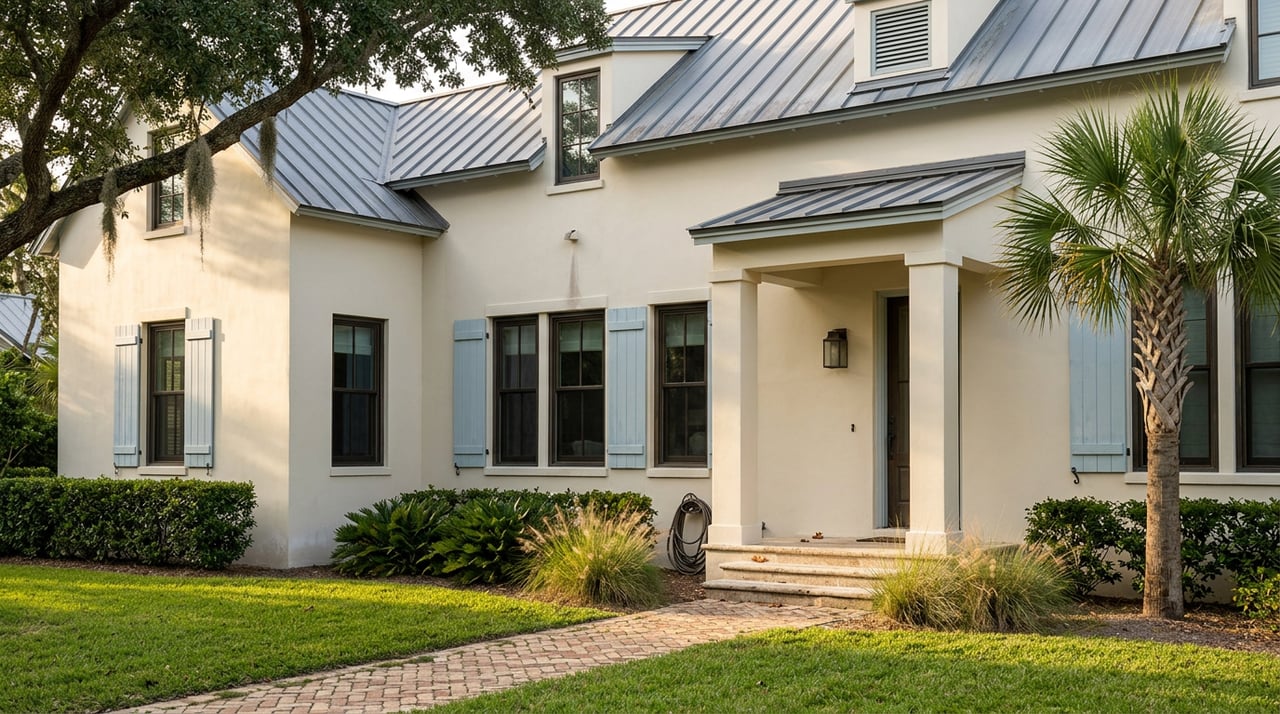
Ask a buyer why Golden Triangle real estate costs what it does and most will say the same thing: it's oceanfront. That answer is only half true, and the half that's missing explains why a dry, non-oceanfront lot a few streets back from the sand in this Melbourne Beach enclave can still price close enough to seven figures to make a buyer blink.
The real driver isn't the water. It's the highway.
The Highway Is the Scarce Resource, Not the Beach
Up and down most of Florida's Space Coast, State Road A1A runs as a four-lane barrier between the ocean and everything inland of it. Crossing it on foot to reach the sand, or crossing it in a car to reach dinner, is simply part of daily life in beachside communities like Satellite Beach or Indian Harbour Beach. That crossing is also what creates the steep price cliff between a true oceanfront lot and the property directly behind it. Pay to be on the water, and you avoid the highway. Don't pay, and you live with it.
The Golden Triangle breaks that rule. It's one of the few stretches in Florida where oceanfront property sits east of Highway A1A rather than facing it, which means the road runs as a buffer rather than a barrier. A dry lot in the Triangle isn't separated from the beach by four lanes of coastal traffic. It's separated by a short residential walk, often past historic homes, to one of four public beach accesses the neighborhood maintains.
That's the mechanism a comp sheet won't show you. The scarcity here isn't ocean access. It's a parcel of Florida coastline where the highway never got to dictate the price gap in the first place.
What the Price Gap Actually Looks Like
Because the highway isn't doing its usual job of separating the haves from the have-nots, the spread between oceanfront and non-oceanfront land in the Golden Triangle compresses in a way it doesn't elsewhere on the Space Coast.
| Parcel type | Typical size | Approximate price |
|---|---|---|
| Dry lot, no direct water | Roughly half an acre | Near $600,000 |
| Oceanfront lot | 100 feet of frontage | Over $1 million |
| Record sale, Shangri-La | Just under 1 acre, 175 feet of frontage | $3.75 million |
That top line is worth sitting with. Shangri-La, at just under 10,000 square feet, stands as one of the most expensive homes ever sold in Brevard County, and it sits in this same small footprint alongside half-acre dry lots priced in the mid six figures. Elsewhere on the coast, that kind of spread between a record oceanfront sale and an inland lot two streets over would be measured in an order of magnitude, not a few multiples. Here, the compression is the story. You're not just buying square footage or frontage. You're buying into a pricing structure that the rest of the coast doesn't share.
The No-HOA Trade Most Buyers Don't See Coming
Golden Triangle listings share a pattern that surprises buyers who assume beachfront luxury comes wrapped in association rules: most of these properties carry no HOA at all. No architectural review committee, no shared reserve fund, no association dictating exterior paint or dock specs.
What fills that gap isn't neglect. It's concrete block construction and hurricane-impact windows, doors, and sliders showing up as the de facto standard across listing after listing in the neighborhood, not because a covenant requires it, but because the market has already priced in what it takes to insure and hold coastal property here long term. Buyers who assume "no HOA" means fewer standards are misreading the signal. It means the standards moved from an association's bylaws to an owner's own construction decisions, and in a small oceanfront enclave without a governing document, the building itself has to do the work a covenant would otherwise do.
That's a meaningfully different due diligence exercise than in a gated or deed-restricted community. There's no HOA document to request, but there's a much closer look warranted at concrete block integrity, window ratings, and roof age, since no association is standing behind minimum construction standards on your behalf.
Where the Walk Actually Leads
The other half of what buyers are paying for is a walk, not a view. Being able to reach Ocean Avenue on foot without crossing A1A puts a small, specific set of local anchors within easy range, and those names are doing real pricing work even though no appraisal line item captures them.
Head south down Ocean Avenue and the walk passes:
- Djon's Steak and Lobster House, a fine dining room at 522 Ocean Avenue named for its owner, Djon Papej, and one of the few spots in town that expects a collared shirt rather than beach cover-ups
- Longboards Oceanfront Grille, a beachfront restaurant built around sunrise views and live weekly music
- Ryckman Park, the town's community gathering point along the Indian River Lagoon, with the historic Ryckman House on its grounds
- The Melbourne Beach Pier, which has held a spot on the National Register of Historic Places since 1984
None of that shows up in a listing's price-per-square-foot calculation, but all of it explains why a dry lot here can command what an oceanfront lot commands in towns where the same walk would mean four lanes of traffic first.
Comparing the Triangle to the Rest of the Coast
The comparison that actually matters for a relocating or second-home buyer isn't Golden Triangle versus itself. It's Golden Triangle versus Satellite Beach or Indian Harbour Beach, where oceanfront and non-oceanfront pricing follows the more familiar Florida pattern: a wide gap, driven almost entirely by whether A1A stands between the buyer and the water.
Paying the Golden Triangle premium on a dry lot only makes sense if the buyer actually intends to use that walk. If daily beach access on foot, dining within a few blocks, and a small-town, low-density feel are part of the decision, the compressed price gap here is buying something specific. If the priority is simply direct ocean frontage at the lowest possible entry point, a comparable frontage lot in a neighboring beach town, where the road does the separating instead of the neighborhood, may be the more efficient dollar.
FAQ
Does the Golden Triangle have a homeowners association? Most current listings in the neighborhood show no HOA. Buyers should expect to evaluate construction quality and hurricane preparedness on a home-by-home basis rather than relying on association-mandated standards.
Is this the same "Golden Triangle" referenced in other real estate markets? No. The name gets reused elsewhere, including as informal shorthand for unrelated luxury corridors in South Florida and for a downtown redevelopment district in Pittsburgh. In Brevard County, the Golden Triangle refers specifically to the strip along Atlantic Avenue in Melbourne Beach, north of Ocean Avenue and east of A1A.
How many public beach accesses serve the neighborhood? Four, giving Golden Triangle owners direct paths to the Atlantic without relying on a single shared entrance.
If you're weighing a Golden Triangle purchase against oceanfront elsewhere on the Space Coast, the math is rarely as simple as price per foot of frontage. Carpenter | Kessel works this specific stretch of Melbourne Beach regularly and can walk you through what a given lot's price actually reflects before you make an offer. List Your Home or start the conversation with the team today.