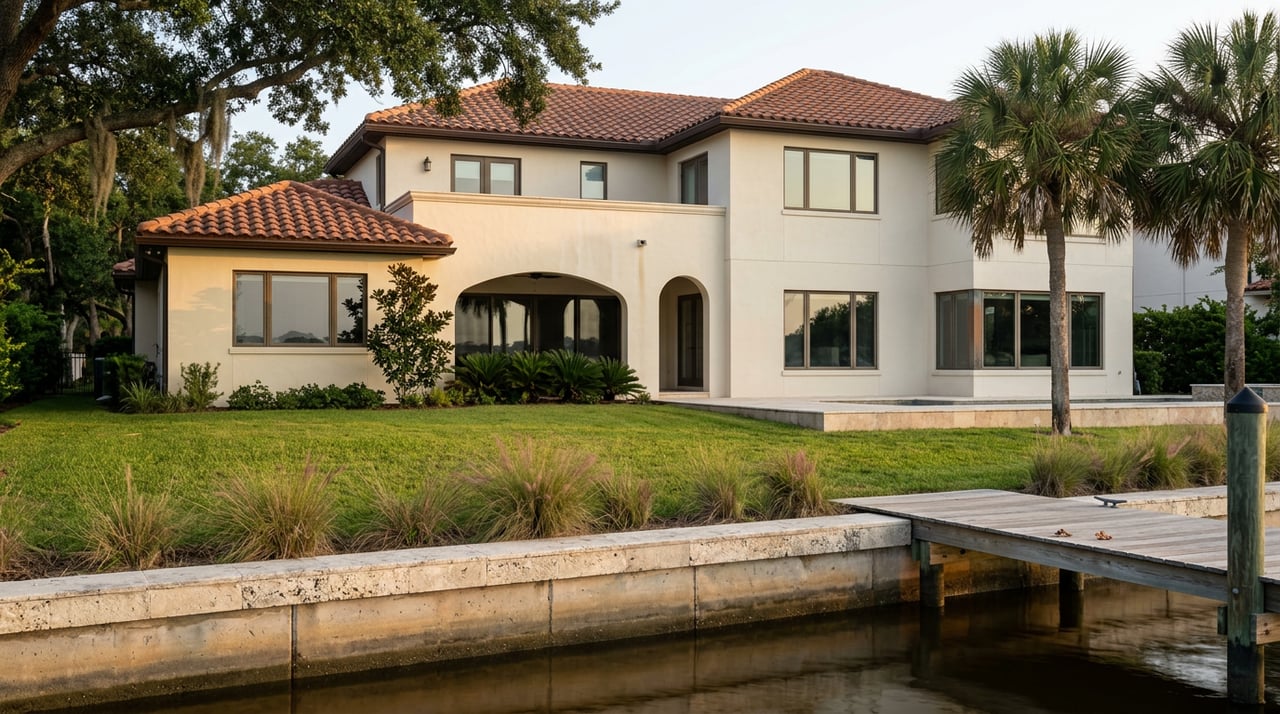
A buyer stood on a private dock on South Tropical Trail last spring, listing sheet in hand, the words "Indian River frontage" still fresh in her mind from the listing description. She looked down. The water was maybe four feet deep at low tide, tea colored, better suited to a kayak than the 34-foot cruiser she'd mentioned to her agent during the first phone call. Twenty minutes north, another dock on the same street carried a boat lift rated for 10,000 pounds and enough depth to run a sportfisher out to the inlet without checking a tide chart first.
Both parcels were marketed as Indian River waterfront. Both are on the same road. The gap between them is the actual story of this market, and it rarely shows up in a listing photo.
South Tropical Trail runs from Mather's Bridge north to the FL-520 causeway on Merritt Island, a corridor once used to move citrus to market before it became some of the most expensive residential ground in Brevard County. Land here touches the Indian River on the west side and the Banana River on the east, and prices on the street run from around $700,000 for an older Florida-style ranch up to multi-million-dollar estates on acreage. That range gets explained, almost every time, as a story about river frontage. It's actually a story about draft.
Two Rivers, Not One Product
Treating "waterfront" as a single category on this street misses what actually separates a $900,000 home from a $3 million one. The Indian River side tends to carry the higher price ceiling because it offers wider open water, longer sightlines, and enough depth in most stretches to support serious boats without worrying about a falling tide. The Banana River side is a calmer, shallower system, better suited to paddleboards, kayaks, and the kind of slow-moving wildlife encounters, dolphins working a channel, manatees drifting past a seawall, that draw a different kind of buyer entirely.
| Indian River side | Banana River side | |
|---|---|---|
| Typical water character | Wider, deeper, more open | Calmer, shallower, more sheltered |
| Boating profile | Larger vessels, less tide-dependent | Kayaks, paddleboards, smaller craft |
| Price tendency | Generally the premium side | Generally the value side |
| At the southern tip | River-to-river lots command a further premium for frontage on both |
At the southern end of the corridor, a handful of parcels front both rivers at once. Those river-to-river lots carry their own premium, and for good reason: a buyer there isn't choosing between the two products, they're buying both.
The Same River Label Hides Four Different Numbers
Here's where the story gets more interesting than "Indian River costs more." Even within properties marketed as Indian River frontage, the actual number that matters, water depth at the dock, varies enough to change what the home is worth to a boat owner.
Carpenter | Kessel's own 9100 S Tropical Trail listing is a useful example of how these numbers get described precisely rather than left to a listing agent's adjective of choice: 2.25 acres running river-to-river, more than 150 feet of Banana River frontage, and a boat dock on the Indian River side fitted with a 5,000-pound electric lift. That's a real, specified number a buyer can compare against another dock down the street.
Contrast that against a property built around Honeymoon Lake, a cove that connects to the Indian River but isn't the open river itself. Listings there have described private docks with roughly four feet of depth, water and electric included, adequate for a smaller boat but a different proposition entirely from a lift rated to hold a 10,000-pound vessel in open water. Both parcels can legitimately claim Indian River access. Only one of them can put a serious sportfisher in the water without planning around the tide.
This is the detail a listing photo can't convey and a listing description often glosses over. A dock is a dock in a photograph. It is not a dock in a survey.
Why the Public Portals Undercount This Market
A search of the major listing portals in mid-August 2026 turned up only four or five active listings for the entire South Tropical Trail corridor, a strip of some of the most valuable residential ground in the county. That's not a market with limited inventory. That's a market where a meaningful share of transactions happen before a property ever needs a public listing.
The mechanism is straightforward once you see it. A deep-water dock on the Indian River side isn't competing against every buyer in Brevard County, it's competing for the attention of the relatively small pool of people who already know they want that specific asset: serious boaters, existing Trail owners looking to move up or down the street, people who've spent an evening at Alfredo's Paradiso or tied up for dinner at Grills Seafood Deck & Tiki Bar and started asking around about what else might come available nearby. Marker 24 Marina functions less like a fuel dock and more like a bulletin board for exactly this kind of conversation. When the buyer pool is that specific and that connected, a seller with the right asset often doesn't need six weeks on the open market. A phone call does the job.
That has a direct consequence for anyone shopping this corridor from outside the network: the four or five listings you find online are not a representative sample of what's available or what things are worth. They're what's left after the properties with the clearest depth advantage and the most connected sellers have already been quietly placed.
What to Verify Before You Tour
A buyer working this street with only the public listings and the photos is working with an incomplete picture. Three questions close that gap fast:
- What is the documented depth at the dock at low tide, not at the listing photo's tide.
- Is this parcel single-river frontage, or a river-to-river lot commanding the premium that comes with both.
- Has this property, or a comparable one nearby, changed hands recently through a private sale rather than the open MLS, and what did that sale actually close for.
None of these questions get answered by a listing description built to sell a feeling. They get answered by a survey, a tide chart, and someone who already knows which docks on this street can actually hold the boat you own.
The Cost of Getting This Wrong
There's a physical friction to this street worth knowing before you fall in love with a lot: South Tropical Trail has no sidewalks and very little shoulder for stretches of its length, with frequent speed bumps keeping traffic slow rather than a walking path keeping pedestrians safe. That's not a dealbreaker for most buyers here, who are choosing the street for the water, not the walk. But it's one more example of how this corridor rewards buyers who verify the physical reality of a property rather than buying the description of it.
The same logic applies to the water. Paying an Indian River premium for a dock that can't hold an Indian River boat is the single most avoidable mistake on this street, and it's avoidable only if someone checks the depth before the offer, not after the closing.
If you're comparing waterfront on South Tropical Trail, or trying to figure out what a specific dock can actually support before you write an offer, Carpenter | Kessel works this corridor closely enough to know which docks hold real boats and which listings are still sitting quietly in someone's phone. Reach out before you tour, not after.
FAQ
Is a river-to-river lot always worth more than a single-frontage lot on South Tropical Trail? Generally yes, since it delivers both the calmer Banana River side and the deeper Indian River side on one parcel, but the premium still depends on the actual usable depth and shoreline condition on each side, not just the fact of double frontage.
Can I verify dock depth before making an offer? Yes. A marine survey or a conversation with a local boat lift installer familiar with the specific stretch of river can confirm depth at low tide, which is the number that matters far more than the depth shown at high tide in a listing photo.
Why do so few South Tropical Trail homes show up on public listing sites at any given time? Part of it is genuine scarcity. Part of it is that a specific, connected buyer pool for the best deep-water parcels means some sales happen through private introductions before a property is ever formally listed.