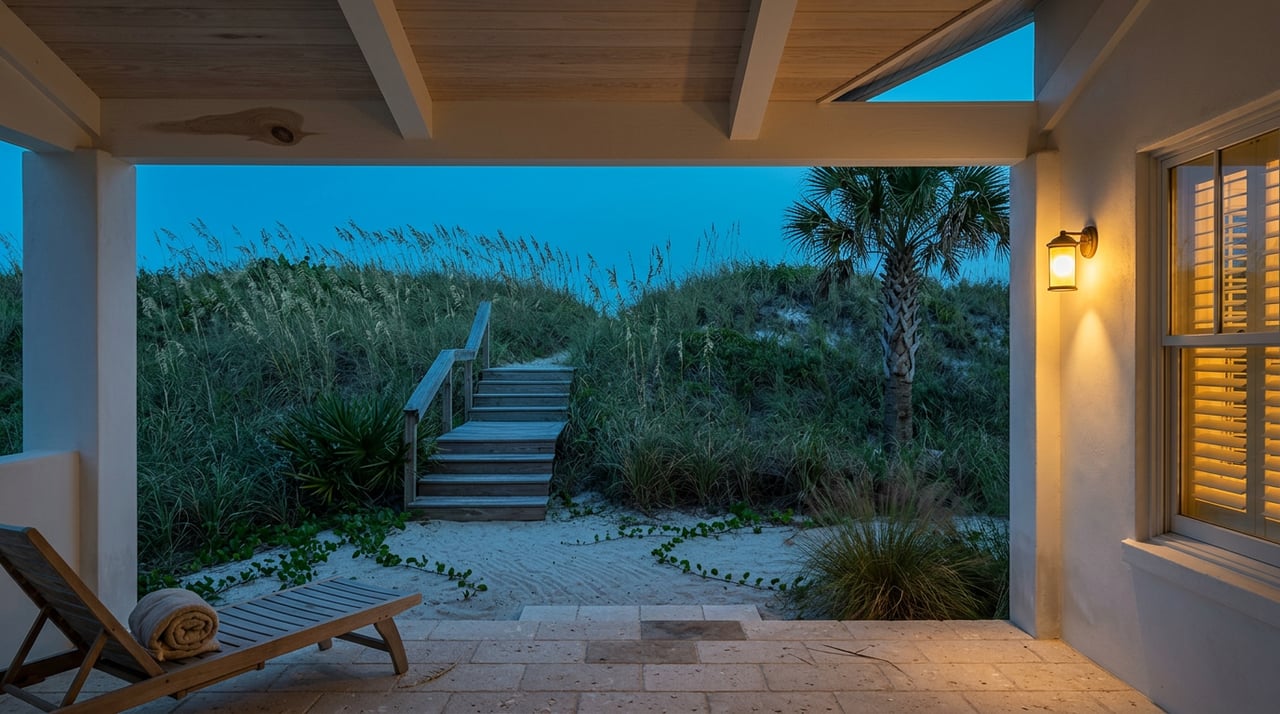
If you live east of A1A, you already know the tell. Neon tape appears on the dunes overnight, porch bulbs get swapped for amber, and the walk from the car to the sand after sunset feels different than it did in April. July is the middle of it.
The thing worth saying out loud, the one most seasonal guides skip, is this: Satellite Beach in summer is not organized around the beach as recreation. It is organized around a six-month set of rules that quietly restructure evening life for every household with a view of the water. That reorganization is the season.
The rule that runs your evenings from May through October
From May 1 through October 31, oceanfront properties must turn off or shield white lights after 9 PM. That single line explains the amber porch fixtures, the closed blinds on beachside condos, and why the pool deck three doors down goes dark earlier than it did in March.
The window is not arbitrary. Nesting season runs March through October, and June and July are the busiest months for Loggerhead, Green, and Leatherback turtles. Right now, in other words, is the peak inside the peak. The Florida context makes the local rule less strange: more than 100,000 threatened and endangered sea turtles nest on Florida beaches every summer, and nearly 90 percent of sea turtle nesting in the U.S. occurs in Florida from March through October.
That is the baseline. Now the neighborhood specifics.
What the three parks look like right now
The city has 17 beach crossovers, including three beach parks with parking, restrooms, showers and covered picnic tables. Each of them plays a different role in July.
- Pelican Beach Park, 1525 Highway A1A. The busiest of the three. 131 parking spaces including 6 ADA, one EV charging station, event venue and pavilions available for reservation, ADA dune crossover and restrooms, grills, a little free library, and two sand volleyball courts. The playground and pavilions make it the daytime park, but the same features make it the after-dinner park in summer, because the boardwalk out to the dune is lit low and stays quiet by 9.
- Hightower Beach Park. Turtle infrastructure by design. This park features a 560 foot elevated boardwalk that helps protect sensitive nesting areas. The dune formations here are steeper than at Pelican, which is why you see marked nests almost every week in July.
- Canova Beach Park. The quieter option, and the one where residents most often catch a nesting event by accident. Signage warns you that the area is known for sea turtle nesting during summer months, with loggerhead and green sea turtles coming ashore from May through October to lay their eggs.
One structural detail residents sometimes forget: 40% of Satellite Beach's beachfront property is in public ownership. That is a high figure for a Florida barrier city, and it is the reason the three parks are not the only game in July. The unnamed dune crossovers between them are where a lot of the quieter nesting activity happens.
If you actually want to see a nest happen
Watching a female come ashore is not a walk-up experience. It is a permit-controlled program, and July is the last full month it runs.
The nearest option is in Indialantic. The Sea Turtle Preservation Society at 111 S. Miramar Ave., Indialantic runs turtle walks under state and federal marine turtle permits. If you have friends visiting for a July weekend, this is the closest program to Satellite Beach that consistently offers evening walks.
Farther south, the walks go through the largest nesting habitat on the continent. The Archie Carr National Wildlife Refuge walks cover the largest nesting habitat for loggerhead sea turtles in the Western Hemisphere, with more endangered green sea turtles nests than any other place in North America, plus leatherback nests too. Walks are offered in both Melbourne Beach and Satellite Beach.
One note worth flagging, because it changes what a resident can recommend to a guest this summer: Canaveral National Seashore had offered Friday and Saturday sea-turtle walks in both districts, but the annual program was canceled for 2026 and will be back in 2027. If someone tells you they booked a walk at Playalinda or Apollo Beach this July, they are looking at last year's page. Send them to Indialantic or Melbourne Beach instead.
The general rhythm of any walk is the same. The whole process takes 30 to 60 minutes, and turtle walk guides know the federal and state laws about what is and isn't permissible, including that no flashlights except for permitted guides and no flash photography are allowed.
The habits that decide whether the hatch actually makes it
None of this matters if the block itself is loud with light or full of dug holes at midnight. The list of resident-level habits is short and specific.
- Flatten sandcastles and fill in holes before you leave the beach. Otherwise, hatchlings can become trapped on their way to the ocean.
- Take your trash with you. Leftovers attract raccoons and ghost crabs, which prey on sea turtle eggs.
- No white flashlights. White light and camera flashes can disorient nesting turtles and hatchlings. Amber and red app modes are fine.
- Stay off the dunes. Sea oats and dunes help protect the shoreline from erosion, and walking on dunes or picking sea oats is illegal and may result in a fine.
- Use the crossovers. Always use the city's boardwalks and dune crossovers when accessing the beach.
The point of the list is not compliance. It is that the same block of oceanfront homes can produce very different hatch outcomes depending on whether the households on it treat these five items as background noise or as the summer routine.
Where the evening actually ends
By the time the sun is down and the beach is quiet, the walk usually ends at a table somewhere. The clustering of options around each park is not random.
Closest to Pelican Beach Park, and the reason many residents make the loop at all, is Da Kine Diego's. On A1A, Da Kine Diego's Insane Burritos is a favorite post-beach stop within walking distance of Pelican Beach Park, and it reads as a Hawaiian-style surf shack plastered with stickers for surf brands. It stays casual enough that a dusk walk in flip flops does not feel out of place.
For a fuller dinner, the local shortlist has held its shape for years. Goombay's Beachside is the ocean-adjacent standby. It is an approachable, beach side spot where you can eat outside and hear the ocean nearby. Long Doggers is the other reliable name that shows up on almost every waterfront list, and the Italian anchors are Antonia & Vittoria Italian Tavern along with Pappagallo's Beachside. Satellite Beach restaurants that offer Italian food include Antonia & Vittoria Italian Tavern, Bizzarro, Cibellie's Pizza and Papagallos Beachside.
If you want the ocean view honest instead of atmospheric, the local caveat about Pappagallo's is worth knowing before you sit down: it is ocean side but the rear parking lot is between the outdoor dining area and the water. Order the pizza, keep the expectations correct.
Why this matters for the block, not just the turtles
Every summer, someone new to Satellite Beach asks why the neighbor's floodlights are off, or why the short-term rental across the street got a note taped to the door. The answer is not a preference. It is the six-month rule, and the reason it holds up is that most oceanfront owners treat it as part of what living here means.
That is the thesis worth carrying into July. The dune line is not decoration. It is the reason the streetlights are shielded, the reason your neighbor has an amber bulb, and the reason a Wednesday night in Satellite Beach in July feels quieter than a Wednesday night in a comparable coastal city farther south. Peak turtle season is the neighborhood's most consistent shared project, and it happens to be running through your front porch right now.
If you own a home along the dune line and want a candid read on how your lighting, landscaping, and outdoor living choices are read by buyers who care about coastal stewardship as much as square footage, the team at Dewayne Carpenter is a good conversation to have before the season turns.