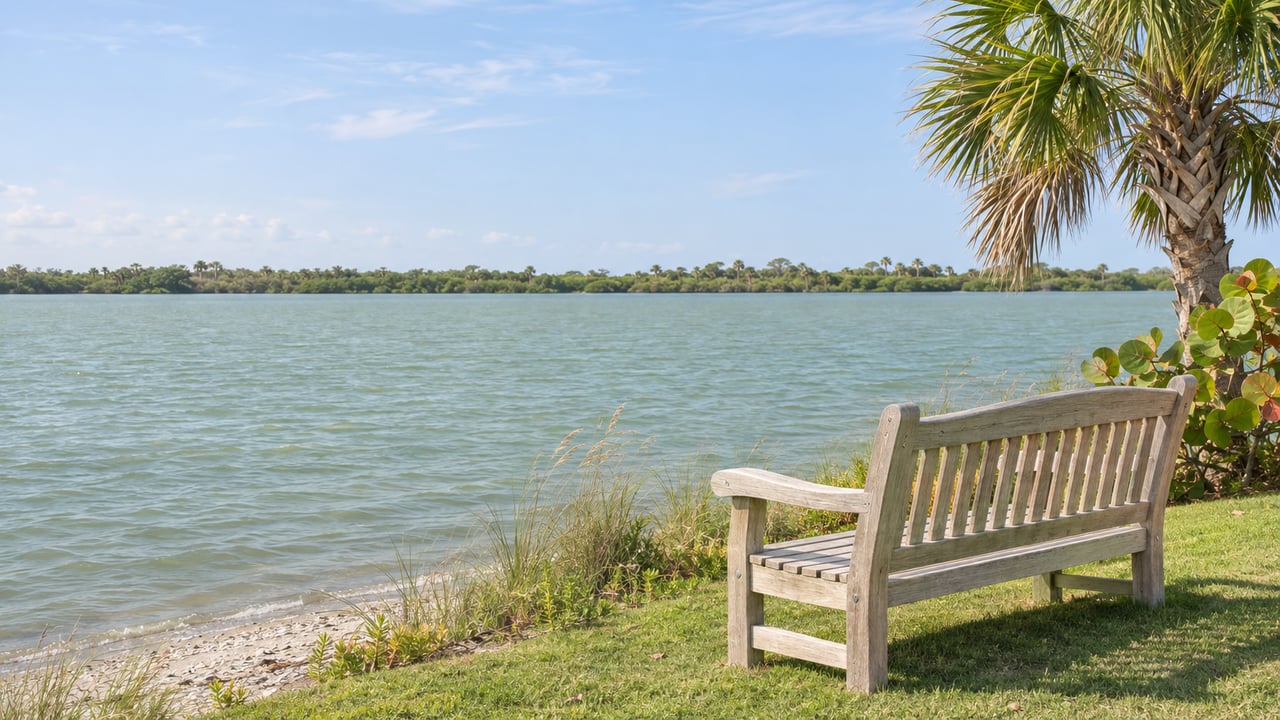
Winter is the season the namesake of Manatee Sanctuary Park is least likely to be in the water off its boardwalk. The City of Cape Canaveral says it plainly on its parks page. The park at 701 Thurm Boulevard takes its name from the protected manatee habitat in the Banana River next to it, and the city "cannot guarantee manatee sightings at the park."
That warning matters most from now through February. When the water turns cold, the Banana River's manatees move to a handful of warm-water sites, and the closest one to Cape Canaveral sits on the Indian River, across Merritt Island. They come back in spring, and in the long-term survey record the Banana River holds the most manatees from March through May. For a resident, that means using the park through the winter for what it is and saving the manatee outing for spring.
Where the Banana River's Manatees Spend the Cold Weeks
The pattern is statewide. The Florida Fish and Wildlife Conservation Commission's guide to seeing manatees says manatees head for warm water such as springs and power plant discharge basins in winter, and spread out across Florida's waterways the rest of the year. A May 2021 summary prepared for NASA at Kennedy Space Center gives the reason. Manatees cannot tolerate water below 68 degrees Fahrenheit for long periods.
FPL's Cape Canaveral Energy Center, on the Indian River a few kilometers west of Kennedy Space Center, draws more than 1,000 manatees during extreme cold, according to the same NASA summary, and the plant releases warm water on purpose when local water temperatures fall below 68 degrees. For decades the Orlando Utilities Commission plant nearby was a second refuge, but its discharge ran from 1960 to 2010, according to a study published in Frontiers in Marine Science on March 17, 2026. That leaves the FPL plant as the northernmost winter warm-water refuge on the Indian River.
The water off the Manatee Sanctuary Park boardwalk is part of a route. The Frontiers study describes the Canaveral Barge Canal, built in 1965, as the short link between the Indian River and the northern Banana River. The southern end of the study area is open to all boating and connects to Port Canaveral, the southern Banana River and the Indian River Lagoon through that canal. Port Canaveral's environmental stewardship page says manatees use the harbor's waters to feed, rest and travel. The Banana River off Cape Canaveral is part of a corridor manatees travel through, and in winter many of them are at the end of it, near a power plant on the far side of Merritt Island.
What the Survey Record Shows by Season
The Frontiers study rests on 385 aerial surveys of the northern Banana River from 1990 through 2024. Helicopter flights started near the State Road 528 causeway and worked north. Over that 35-year span, manatees turned up in every season, with the highest counts in spring and the next highest in summer. The single-survey peaks were 1,072 manatees in spring 2012 and 757 in summer 2012. In cold periods, defined in the study as air temperatures below 10 degrees Celsius, about 50 degrees Fahrenheit, counts were typically very low.
The study defines spring as March through May and winter as December through February. The 2021 NASA summary describes the same rhythm. Manatees use the area year-round except during extreme cold, and the highest numbers come in spring and fall, when animals stop over on their way north and south.
The counts have also fallen well below their old levels. Across the 2011 to 2015 seagrass die-off years, the northern Banana River averaged about 490 manatees per survey. From 2023 through 2024, the average was about 119 per survey, ranging from 1 to 420. Annual counts fell to their lowest point in 2019 and began to tick up in 2023.
Why Spring Has More to Offer Each Year
Manatees in this stretch of the lagoon follow the seagrass, and the seagrass is coming back. The 2025 lagoon-wide seagrass survey, summarized at the July 2026 Save Our Lagoon Citizen Oversight Committee meeting, found a 72% increase in coverage from 2023. The largest gains by area were in the northern Indian River Lagoon and Banana River segments. Coverage was still about 47% below the 2007 to 2009 baseline. More grass in the Banana River means more forage for manatees passing through in spring.
The animals are already in local news this fall. In October 2026, Florida Today reported that a manatee named Rosalyn was found in the Banana River in Cocoa Beach and moved to the rehabilitation center at Brevard Zoo.
The Park Between Now and March
With fewer manatees in the river, Manatee Sanctuary Park in winter is a neighborhood park, and a well-equipped one. The city lists a half-mile paved fitness trail with 10 exercise stations, a covered boardwalk along the river, picnic tables and grills, a pavilion with a serving kitchen, and a playground. The city's Fall and Winter 2025-26 activity guide adds restrooms, a paved pedway and EV charging, and lists park hours as dawn to dusk.
The pavilion is the part of the park most suited to a holiday gathering. Its RecDesk listing describes a serving kitchen with a refrigerator, sink and concession window, 16 tables seating about 96 people, and 44 paved parking spaces with limited overflow. Reservations go through city staff. A December birthday or a January family reunion fits there easily.
The fitness trail draws regular programming as well. The city's November 2026 class calendar lists Zumba with Hailey at the park on Tuesday and Thursday evenings at 5:30. Check the city's class schedule for the December lineup before planning around a session.
The boardwalk is still worth a slow walk on a winter morning. Manatees use these waters in every season of the survey record, so a sighting in December is possible, just not something to count on.
Planning the Manatee Trip for Spring
A spring visit to the same boardwalk has better odds, and the best-documented public viewing spot in the area is on the national wildlife refuge that shares Merritt Island with Kennedy Space Center. U.S. Fish and Wildlife Service materials for Merritt Island National Wildlife Refuge place the Manatee Observation Deck at Haulover Canal, off State Road 3 about 10.5 miles north of the refuge Visitor Center. The refuge says manatees "frequent this spot when the water is warm and can be seen reliably in spring and summer." The refuge lists its roads, trails and boat ramps as open year-round from sunrise to sunset, and the Visitor Center as open Tuesday through Saturday from 8:30 a.m. to 4 p.m. FWC's statewide list also includes the Haulover Canal platform and notes an entrance fee for the refuge.
Haulover Canal connects the Indian River Lagoon and Mosquito Lagoon. In the Frontiers study, surveys of Mosquito Lagoon from 2016 through 2024 counted more manatees than the northern Banana River in every season and year. Single-survey highs there were 1,084 in summer 2022 and 1,032 in spring 2017.
For guests who are in town now and want to see manatees, FWC lists warm-water viewing centers farther afield, including the free Manatee Lagoon, an FPL Eco-Discovery Center in Riviera Beach, which has an observation deck by a power plant's warm-water discharge. Closer to home, wherever you look for manatees, FWC asks viewers to keep their distance, use binoculars and leave resting animals alone. Its viewing guidelines have the details.
So from now through February, Manatee Sanctuary Park is a place for the fitness loop, the grills and the pavilion. In March, go back to the boardwalk, and on a warm spring weekend, make the drive up State Road 3 to Haulover Canal.
If a spring on the Banana River has you thinking about a home on the water in Cape Canaveral or across the river on Merritt Island, the team at Dewayne Carpenter is glad to walk you through the riverfront options on both sides.